
I'm sure that we gringos have a smell about us that isn't very pleasant to those who aren't gringo. Likewise, there is a prevailing aroma that permeates the air when you are mashed like potatoes in a bus full of indigenous families that have recently gutted and smoked their pigs. God bless them all. They are hard workers and have faced much adversity with a stoic and single purpose mindset. I'm sure that clean clothes and body is a luxury that is neither practical or even possible before jumping on the bus. I was an Iowa farm boy after all and anyone who has worked with pigs knows that hog smell becomes a part of you no matter how many times you shower. Add a shot of smoldering ash to that flavor and you have a smell that will overturn a sewer rat's innards.
So here we are, most reserved seats filled, chugging merrily along in our underpowered bus crawling up the insane inclines of the Andes. The views along the way are at times spectacular with the carpeted slopes of vegetables and fruits. It is best not to look at the side of the road where littering is not yet a cultural taboo. More on that later. Up ahead I see a crowd of indigenous massing at the side of the road, obviously intent on sharing the stagnant confines of our mobile vessel. The bus stops and the people crush ensues. I am reminded of a food processor and we're all in the tube with the giant's hand pushing the plunger down. The remaining unbooked seats quickly fill and like the locks in Panama, our canal is brim full and two times human capacity in moments. Red lights, traffic lanes and legal bus capacities are largely a suggestion in Ecuador. Sitting on the aisle seat, memories of high school wrestling filled my brain. Your adversary was sweaty and sticky and there was no polite 'space' provided for your personal comfort. Like wrestling, this was just a competition to survive and not be pinned. Unlike wrestling, there were no winners. Everyone gets pinned. You were already on your back, so a neck bridge seemed like the only defensive answer. After a while though, your neck just gives out and you get pinned. I kept waiting for the whistle to blow so I could breathe at last, but the whistle never blew. The pungency of the aforementioned odors was now being branded into my clothing and skin and I was one with the slayers of hog. I knew we were only two hours into our ten hour odyssey. Enter claustrophobia. Could the breasts of my matronly tormentor, perfumed au swine be suffered on my breathing orifice for eight hours? I confess a bit of panic. Thankfully Rachel was on the window seat and was still smiling from the adventure. She pulled the little camera and snapped a picture of the darling baby strapped to the back of the woman whose maternal organs were slowly suffocating me.

I shared my thoughts of panic and nausea with Rachel. "You have to have rain before you can enjoy the sunshine" she said. At last the sun broke. The bus ground to a halt, the driver kept his foot on the brakes, and the bus regurgitated it's excess human contents to the countryside. I could breathe again! The sun was shining at last! Rachel was right, again.
This adventure however was far from over. We're rolling along about 50 mph on a relatively shallow downward glide and KABOOM!!! The bus rocks and rolls and it feels like we lost the underside of the bus altogether. Fortunately the bus driver knows NOT to lay on the brakes. I'm sure the countryside has swallowed more than one or two buses with bald tire blow outs. As we rumble to a halt the remaining passengers show mixed feelings of glee and dread. There is no  way the bus driver would keep passengers on boa
 rd when fresh air beckons outside. The opportunity for escape is an unexpected relief from the aromatic vestiges of smoldered carcass left as a gift from our former passengers. The dread is the unknown attached to how long we’ll be delayed at the side of the road. I’ve discovered my farmer background comes back frequently now that I’m in Ecuador. I can’t explain that, but suffice it to say, I wanted to help with this countryside breakdown. When I looked at the exploded tire, the lug nuts on the wheel, the tool the driver had to remove them, the feeble jack, and the bald replacement tire sitting in the spare tire compartment, I knew we were sunk. Well, not sunk like the Titanic exactly, but the iceberg definitely did some damage. I’m pretty sure this tire was previously used by the 16th century Incans and certainly the lug nuts were smelted in their cauldrons. After about a half hour of futile struggle on rust welded lugs with a wrench salvaged from the sea floor, the bus driver gave up. We reloaded the bus and thumped away to a nearby service station. The attendant there took one look, winced, shrugged his shoulders, pointed vaguely in another direction, and we were once again thumping along. Finally we found a place with a real wrench, a real jack, and the driver once again unloaded the spare tire with the rubber thickness of a ten cent balloon. Satisfied that we once again had something resembling round under the bus, we roared off arriving in Quito only two hours behind schedule. I’m sure that bus is still out there with that thin tire. I'm guessing that exploded tire is also still in the spare tire compartment also. Next time you decide to use Oriente Turismo, check the tires before you board. I’d suggest Imbabura Lines if you can manage it.
 way the bus driver would keep passengers on boa
 rd when fresh air beckons outside. The opportunity for escape is an unexpected relief from the aromatic vestiges of smoldered carcass left as a gift from our former passengers. The dread is the unknown attached to how long we’ll be delayed at the side of the road. I’ve discovered my farmer background comes back frequently now that I’m in Ecuador. I can’t explain that, but suffice it to say, I wanted to help with this countryside breakdown. When I looked at the exploded tire, the lug nuts on the wheel, the tool the driver had to remove them, the feeble jack, and the bald replacement tire sitting in the spare tire compartment, I knew we were sunk. Well, not sunk like the Titanic exactly, but the iceberg definitely did some damage. I’m pretty sure this tire was previously used by the 16th century Incans and certainly the lug nuts were smelted in their cauldrons. After about a half hour of futile struggle on rust welded lugs with a wrench salvaged from the sea floor, the bus driver gave up. We reloaded the bus and thumped away to a nearby service station. The attendant there took one look, winced, shrugged his shoulders, pointed vaguely in another direction, and we were once again thumping along. Finally we found a place with a real wrench, a real jack, and the driver once again unloaded the spare tire with the rubber thickness of a ten cent balloon. Satisfied that we once again had something resembling round under the bus, we roared off arriving in Quito only two hours behind schedule. I’m sure that bus is still out there with that thin tire. I'm guessing that exploded tire is also still in the spare tire compartment also. Next time you decide to use Oriente Turismo, check the tires before you board. I’d suggest Imbabura Lines if you can manage it.
Our arrival in Quito was a little daunting as we’re small town folk from Cuenca. You can take a taxi from one end of Cuenca to the other in a half hour. Quito is a BIG city. I had Ximena’s new address in my pocket and she gave some additional information that would hopefully be helpful to the taxi driver that would take us to her new apartment. The taxi driver was without clue as to the whereabouts of the streets that described her address and when he and four others of his colleague conferred for several minutes, each scratching appropriately and inappropriately their bodies so as to stimulate recognition, my confidence that we would see Ximena this night began to ebb. When they broke up, I asked “Claro?” in my expansive bilingual repertoire, and he of course answered Si! The compadres of accomplice quickly vanished so as not to have a remembered part in this conference of confusion. I was pretty sure this was going to be another Odyssey. Rachel in her calm and oblivious demeanor was enjoying the sounds and sites of the big city. I didn't want to spoil it for her by telling her we might be camping in a yellow taxi this night. Some day I’m going to make a million equipping taxi drivers in Ecuador with GPS mapping so that they can find their way. As long as pedestrians exist, they will resist my sale however. The driver stopped to ask at least 8 different pedestrians where Borja Lavayen and Ignacio Santa Maria streets were and later where Edificio Metropoli was. Taxi directions I've concluded is an Ecuadorian social project and would certainly be ruined with clear street signs, maps, and other gringo-like abominations. I’m really not sure why there aren’t street signs in Ecuador. There ARE a few signs posted on some buildings, but they’re usually pretty obscure. Street maps aren’t big here either, so if you have one, you must be a gringo. If you know how to read one, you're absolutely a gringo. I’ve tried to put one in front of taxi drivers in Cuenca and when they turn the map over about three times I know they'd not score high on Iowa Tests of Basic Skills Map Reading. I’ve heard the taxi drivers are going to have a strike, so I hope they’re asking for street signs, maps, and GPS too. I’ll even march with them if we can find the street corner to start marching on. I know I sound jaded a bit about the senseless-honking, merciless maniac marauders of the Yellow Hornet variety. As a bike rider in Cuenca, you'll remember that death stalks you in the form of the two great tyrants, The Blue Angels of Death (BAD buses) and the Yellow Hornets (or should we call them the Yellow Horn-Honkers) both of whom despise anything smaller than themselves. These are vehicular predators to be sure. Thank heavens the majority of Ecuadorian drivers are civil, kind and courteous to their two wheeled friends. God Bless all of you!

Seeing Ximena and Miguel was definitely old home week (yes, we found our way before dawn). I was excited for them to meet my new bride, and for Rachel to meet the people that treated me so kindly for five weeks in Quito. Ximena said it seemed kind of like a dream that I was back in her house. I know how she felt. It was sort of surreal. Our grand prize for visiting them was enjoying Miguel as our city guide for the entire New Years Eve day. Miguel is a first year medical student that I confidently predict will one day be president of Ecuador. Miguel Perez, remember that name. You heard it here first. Move over Correa, this country is ready for a unifying, healing, and God-guided hand. I hope for Ecuador that I am right. Miguel is brilliant in the sciences and writing, accomplished in music, but his passion is the history, culture, and politics of the people and country he loves. As he took us around the historic district in Quito he told us the history of each cathedral and every colonial building of import. We learned of the great battle on Pichincha where Simon Bolivar, Mariscal Sucre and Abdon Calderon helped win independence from the Spaniards. You see these heroes’ names on parks, streets, and buildings everywhere in Ecuador but when you hear about them from Miguel, they become old friends and your heart swells with pride to know them and feel their spirit in every cobblestone.

There were two main sites I wanted Rachel to see after we visited the historic district. El Panecillo, a statue of a winged Virgin Mary stands high above a hill that overlooks the historic district and you can literally see the 50 mile long city end to end from the tower.

I guess I like high places because the other ‘must see’ was the exciting ride up the cable teleferico (mountain gondola) to have an even more panoramic view of the city and also to have fabulous views of Pichincha. At around 14,000 feet, you need to limit your time up there both for the cold and the thin air, but the views are worth it.

I guess I like high places because the other ‘must see’ was the exciting ride up the cable teleferico (mountain gondola) to have an even more panoramic view of the city and also to have fabulous views of Pichincha. At around 14,000 feet, you need to limit your time up there both for the cold and the thin air, but the views are worth it.


Rio Amazonas is the street to be on during the New Year’s Eve early evening hours. It’s like Mardi Gras with children. Yes, the little ones are out too, whole families old and young alike. As you flow with the crowd you pick up the essence of the people of Quito.

Returning to Ximena’s after the walk with the masses was a bit of a relief and we knew that good food awaited in the traditional midnight feast. Turkey was the holiday bird and Ximena knows how to cook. Joining us for supper were two of Ximena’s sisters and brothers in law, 2 nieces and a nephew. Miguel and his double cousin Alejandra are both medical students. Ximena’s sister Anita is Quito International Airport manager, her daughter an attorney for the airport, and her husband chief of security. There’s no lack of ambition or brains in this family. This is the kind of family that presidents come from.

We went outside at midnight to watch the fireworks. This city likes their fireworks. It must be that every family that can afford one buys a fabulous firework and shoots it up at midnight because they were going off all over the city and it was crazy colorful and beautiful. On the streets were little fires of burning effigies. There’s a lot of traditions here around the effigy burning, but mostly I think you burn your political enemies, your most disliked teachers, the taxi driver that tried to run you over, and anyone else that you need to get out of your mind before you start the new year. You see racks and more racks of masks of all types and demeanor that are for sale before New Years. It is your duty to buy the mask that looks most like your adversary to put on a scarecrow-like figurine and soak it with a bit of blazo for holiday cheer. It truly seems like an odd custom, but they do it all over the country, perhaps most especially in Quito. Perhaps that's why Ecuadorians are by nature such kind and sweet people. They wholly expunge their angst each year. Next year I'm making a cardboard blue bus and yellow taxi and I'll have a fire that will foster a calm in me that will surely make me as my kind Ecuadorian brothers. Nah.

The next day, New Years Day, we were off to Otavalo by bus from Quito. Our intent was to make it to the major indigenous market before it closed. Saturday is the biggest day of the week by far, so everything had to go right for us to arrive in time. The enormous $6 alpaca scarves beckoned.
 This time our bus was really clean and nice and no crushing excess travelers. We decided we’d better take the short taxi drive from the Otavalo bus station to Cotacachi to dump our bags at Hostel El Arbolito before we doubled back to Otavalo. We met my old friends, brothers Roman, Francisco, Edgar, and Jaime Galindo. The Galindo brothers and their wives rally at the family owned Hostal El Arbolito. Jaime and his wife Ida operate the hostal full time with the other brothers and wives contributing when then can. Edgar watches the family owned internet cafe next door when he's not at his government administrative job in Otavalo. Roman and his wife Beatrice also help on weekends when Roman isn't at his engineering job in Quito during the week. Francisco just happened to be visiting from the US for a month long holiday to Cotacachi. We were glad he was there because his English is excellent and he was able to bridge the barrier for us when needed. Francisco will some day build a house on his lot in Cotacachi and retire there.
 We made it to Otavalo before the big market day closed, but barely. We simply dawdled too long in Cotacachi. We'll go back there again some day soon. The Imbabura province simply offers much of what we are looking for in our semi-retirement. Remember my earlier comment about trash on the Pan Am Highway between Cuenca and Quito? When you drive north out of Quito leaving the Pichincha Province and enter the Imbabura Province, the roadside immediately becomes pristine. Maybe there's a reverence here for Father Imbabura and Mother Cotacachi. Whatever it is, you will notice the difference and you will be amazed and proud of what the people of this province have accomplished. It kind of makes you want to just live there.
We found a yet unnamed start-up cafe next door to El Arbolito that served us well when we wanted our extended morning coffee and breakfast. Blanca was an exceptionally sweet gal who treated us like we were her only customers. We were. I'm really not sure many people know they're even there. We had huevos (eggs) con queso, tocina (bacon), jugo (juice), and multiple hot queso sanduches along with unlimited coffee for $2.
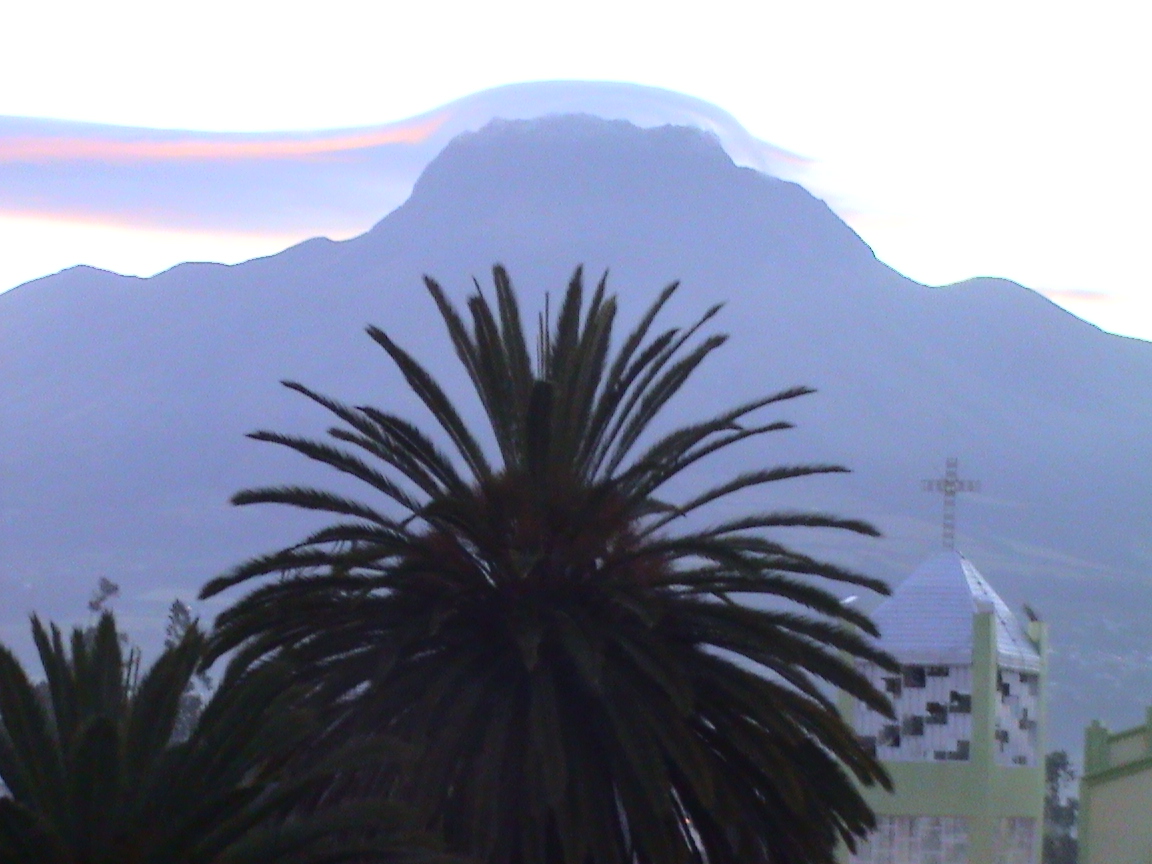
Cotacachi hasn't changed much since I was there a year ago. It is still extremely clean, quiet, friendly, safe, and the views of Mt. Cotacachi and Mt. Imbabura are just incredible. I fell in love with it a year ago and the feeling hasn't changed. It is certainly NOT for everyone. If you like night life, it's not for you. The streets temporarily roll up for siesta at 1PM, again at 6:00PM, and don't exactly get up with the roosters either. Commerce is an accidental biproduct of pedestrians walking by the right tienda at the right time. Too much commerce would cause chaos, and chaos isn't wanted here. The quiet streets are safe to bicycle on, the sidewalks safe to walk on. There's no buses belching their toxic fumes and the sky is so clear and blue you'd swear your life is in high definition. The streets are paved in brick and cobblestone, the sidewalks in a colorful and tasteful mosaic. Calle Cuero (Leather street, officially Diez de Agosto) is teaming with clean, modern, tiendas tastefully presenting articles manufactured by local artisans. I simply had forgotten how nice these shops are. There are droves of attractive cafes, some quite upscale with prices approaching the gringo level, and others that offer really good food at a very reasonable price. One night we each had a thin personal pan pizza with a drink for $1.

What really separates Cotacachi and the Imbabura Province in general from everywhere else we've been in Ecuador is the number of available properties in secure settings with gorgeous views, huge yards, infrastructure, and quality construction for nominal cost. There again, if you like the nightlife, this place isn't for you. We decided that while we were there we would allow ourselves the notion that two country people like ourselves are really meant to be living in a setting where the biggest event of the week might be Pedro's errant cow running loose in the street! I could help Pedro rope that vaca and become a local gringo legend. We've been in Cuenca for months where culture, music, fine dining, history, and colonial architecture pulse through the city like the Tomebamba and we simply don't use it. We ride our bikes, but it's with the understanding that we must be on high alert or perish. As we sat on the bench in the quiet little park in Cotacachi with the warm Imbabura sun drenching us we took pause, looked at each other, and with a knowing look submitted to each other what was already in our heads and hearts. This was home.


