Saturday, April 14, 2012

Eternal Spring in Cotacachi

So what is the climate REALLY like in Cotacachi?  It is comfortable, steady, and somewhat predictable.  It is never COLD and never HOT.  Some call it eternal spring. There are hundreds of things that I love about Cotacachi, but the weather is among the top five.

Snow dusts the top of Father Imbabura


If you ask 10 locals about the climate of Cotacachi you will most assuredly get 10 entirely different responses.  Perhaps people are numbed into complacency.   You see there are just two seasons in Cotacachi, summer and winter.  No, I don’t mean Currier and Ives Christmas nor am I talking about those Lazy Crazy Hazy Days of summer either.   Winter here is sometimes rainy; summer is nearly always sunny and fair.  Summer is June through September. 
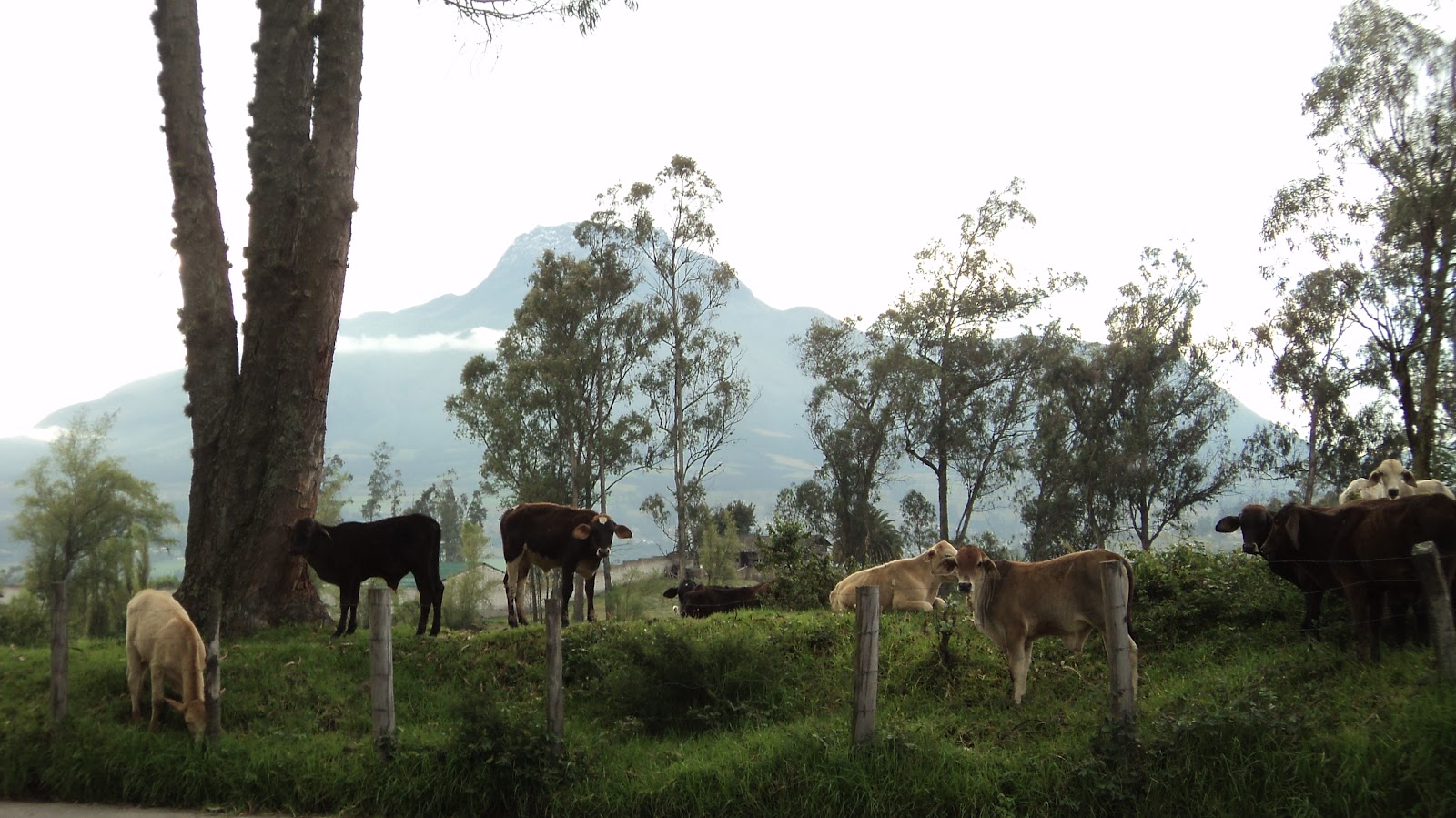
Brahma calves graze and lounge in lush grass in this pasture just outside Cotacachi in summer and winter.


The average daily temperature is 61 degrees every day all year long.  That means you top out on average about 71 and bottom out at 51.   71 feels like 78 here by the way.  It has something to do with the 8000 feet above sea level thing.   The sun also rises and sets mas o menos the same every day also.

I used to live in northwest Iowa.  Our winters there were as harsh and as long as in Minneapolis.  When my sister’s family came to visit in winter from Fairbanks they’d be chattering from the cold.  I made a promise to myself in January 2010 that I would never endure that kind of winter ever again.  I haven't.

Rachel is from Oklahoma.  110 degrees in Tulsa is not that unusual and it can go on for weeks.  Oh, and they have high humidity too.  We will never pay for heating or air conditioning ever again, ever.  We will be able to go for a walk outside in comfort every day, the rest of our lives.

I just smiled this morning as I was riding my bike along this meadow.  I could see the snow on Mt. Cotacachi and knew it would never fall in this land of Eternal Spring.


Do I miss the change of seasons?  Well I loved spring in the US.  It was always a thrill when I could find my mailbox again.  The promise of new life, color, and beauty put an extra bounce in my step.    I also loved the fall.  The color of the trees was just God going crazy with His paintbrush.  I miss that a lot.  The only thing I didn’t like was the promise that winter was on its heels.  The visual euphoria was short lived.   Life seemed always to revolve around the dread of winter.


I stopped my bike to visit with this handsome young couple walking to Quiroga for work this morning.   I was rambling away in my feeble Spanish as the young man smiled, looked directly at me, and began to speak in fluent English.  I told them Rachel and I used to live in Cuenca but we followed our heart to the Imbabura.  He said he left New Jersey to return home to his bride and live the life he knew he was supposed to live.   I just wanted to hug them both.
 
What do you wear in Cotacachi?  Well, again you will get many answers to that question.  You will see many answers to that question.  In the same moment in time you will see an indigenous man with a warm coat and hat and a gringo like me in a t shirt.  I’ll be on my bicycle wearing a t shirt and a sweatshirt over it at 7:30 AM.  By the time I get back for breakfast the sweatshirt is tied around my neck.  Eternal spring. 

Monday, April 9, 2012

Hacienda San Isidro

A week ago our good friends from Cuenca, Mike and Patty Grimm invited Rachel and me to join them for lunch at Hacienda San Isidro.  San Isidro is a well kept secret among the locals of the Imbabura it seems.  I only knew that we had to go through neighboring Quiroga and from there it was by guess and by golly.  Only a few locals could direct us to the right road (path).

We had one of those days that all of us will remember the rest of our lives.  The views from the hacienda were stunning and never seen by your average tourist.   I loveTaita (father in Quichwa) Imbabura and photograph him ad nauseum.  To see Mt. Imbabura in this way on this day was special.  All his subjects (the villages of Cotacachi, Otavalo, Quiroga, San Roque,  San Juan de Illuman, Peguche, and Atuntaqui to name a few) seemed to lay peacefully at his feet.

We had a wonderful brunch but the personal tour of the hacienda by the owner was what made our day.  Mike and Patty did a blog for this day and they took some beautiful photos.  Please visit their blog.


Sunday, April 8, 2012

Intag


I admire people who at nearly 69 years old take up a challenge that would be daunting to those half their age.  Lee Wright is one of those people.   His knowledge, skill, and experience enable him to do extraordinary things.  Yes, he's MacGyver.   Then there is Lauren Pohn who at nearly the same age is willing to extend herself into the unknown without much experience at all.    If Lee lived in the 1840's and 1850's he would have been a wagon master in a wagon train going across the sierras.  Lauren would have had the faith in her own tenacity to get on that wagon train, leave the comforts of Boston and go west.

But even Lee and Lauren need help.  It takes a local who knows the lay of the land and the people who are married to it. It also takes someone who has some serious complimentary skills himself.  That person would be Patricio Galarza.   Patricio just happens to be Wright's and our architect at Yanapamba. Patricio also has a passion for this Ecuadorian agricultural paradise known as the Intag.

The Intag is a region west of the village of Cotacachi but still in the Cotacachi canton.  It is an area that represents a piece of the old Ecuador much less affected by the Pan American Highway.  You see the Pana is like the main artery of Ecuador and those that travel and live along it see a relatively populous and commercial Ecuador.  If you want to see the road less traveled, you must get on a less traveled road.

The Intag region is generally lower in elevation than the village of Cotacachi which at 8000 feet above sea level cools to the low 50's at night and only reaches the mid 70's during the day.   I found the Intag to be a little more humid as well.  I'm sure that 70 inches of rainfall annually is a contributor to that effect.  The soil is rich there too.  Too much rain you ask?  Not really.  You can plant things on a slope that almost defies gravity and water doesn't linger there longer than necessary.  But I can tell you that it makes the rivers and streams rather robust.

As a former Iowa corn and livestock farmer I see things relationally to my past life.  I could jump in my air conditioned, sound proofed tractor, till the soil, plant my crops, spray with bad stuff and watch it all grow weed free and with a dependable outcome.  In the fall I'd be in a heated combine and the grain would flow like a river into the hopper.  The grain would then be mechanically elevated into massive bins where it was exactingly conditioned for storage.  The winter was spent on the computer analyzing stochastics to determine the best time to sell.

It's not like that in Ecuador.  The six figure tractors and combines are replaced with legions of willing workers that toil happily, share in the food wealth and support their families with their wages.  Iowa and Ecuador are on different planets agriculturally.  I know just enough to look at the dynamics of both of them and marvel.  Sometimes the old way is the best way, especially when you're on the slopes of the Andes.  You can rest assured that Lee won't be padding Tenneco’s or Monsanto's corporate profits. He will help feed many families with healthy food.  That's a novel idea!

So here are the four of us, the inquisitive displaced farmer/banker (me), MacGyver (Lee), the pioneer woman (Lauren) and the architect (Patricio) who makes dreams a reality.  The pioneer woman (Lauren) wants the architect (Patricio) to figure out how to build a bridge over a rampaging river to her property.  MacGyver (Lee) needs Patricio's truck to deliver a very heavy load of floor tile to his casita on his little farm. I'm just there to add a little muscle for the tile delivery and to share in the adventure.  Patricio is just a kind and generous man who takes the day off to help his gringo friends realize their dreams.


Our route took us from Cotacachi through Quiroga, up to Lago Quicocha, and off on a pretty primitivo road that would keep us bouncing in our seats for the next 3 hours.  As we gained in altitude we lost our scenery.  We had entered the cloud forest that kept us in a dream like state until we broke through on our descent into  the Intag.


It was the Face of the Inca that greeted us on the descent into Apuela.  I still don't know whether the Face was sculpted by man or by nature, but it is an amazing likeness none the less.


Apuela is a functional, no frills Andean farm town.  A general store sells fertilizer, cement,  fencing supplies, veterinary medicines, paint and nails.   Another store sells sandpaper and light bulbs.  Like many other pueblos in Ecuador, the tiendas in Apuela don't necessarily sell a logical array of goods.  It's just what the vendor decides to sell.  Once you get used to this system of commerce you have made your first step in acclimating to Ecuadorian retail.  


Likewise, the transportation system fits the roads or the lack of them.  Buses from Cotacachi and Otavalo reach Apuela once or twice a day subject to washouts and rock slides.  Once in Apuela your transportation locally is in a truck-bus (see above picture) when a sufficient number of pasajeros induce the local conductor to fire up the engine.  Uncle Juan may also be able to offer a ride in his pickup.  Otherwise caballos are an excellent choice if the distance is long, the grade is steep, and the roads are missing.  If you're not fortunate to have access to a horse, then your God-given feet do just fine.


When the work is done Ecuadorians like to play.  They are as good at play as they are at work.  I'd put this local team against some of the best college teams in the US.  Their teamwork and athleticism is amazing.


After about four blocks we reach the other side of Apuela and are headed again to the campo (countryside).  Our next stop is the smaller pueblo of Cuellaje.  


Cuellaje is laid back, neat, and clean.  Everyone says Ecuador is like the US in the 1950s.  I beg to differ.  Every city and town is different. Cuenca is uber-modern with some wonderful historic architecture.  Cuellaje is more like 1930's or 1940's Midwestern USA with a Latin twist.  Since cell phones don't work here there's a bit of an isolation factor.  Even the road doesn't get you to the big time (Cotacachi) in a hurry.  Nobody is in a hurry anyway, so what's the point.  Let's face it, technology, communication, and infrastructure changes culture.  I like the culture here just fine.


Even the residential areas of Cuellaje are tidy albeit weathered.  All things man-made have a story, a history, and a bit of soul. Would I live here?  Well, not yet.  If the world comes tumbling down, definitely. Cuellaje doesn't need the rest of the world.  


So now we're on the short leg of the trip from Cuellaje to Lee's little casita in the campo.   


The views along the road are like that in Fellowship of the Rings.  I kept expecting Bilbo Baggins to step out on the road at any time.  Instead it was Juan Valdez' son Juanito.  Well, use your imagination.  If you go on this trip and don't fall a little more in love with Ecuador then you don't have a heart anyway.


So now we're off to Lee's casita with the floor tile and the unloading process.


We can only get so close to the casita with the truck


So I finally get to contribute a little to Lee's adventure in Andean homesteading.


Lee's slippery little dug out steps down to his house weren't the best match for carrying 50 lb packages of tile.  We all wanted the tile and our limbs to be unbroken so using the grassy slope was the better bet to achieve our mission.


Lee and Susan's casita will soon be the 'weekend retreat' where guys go to tell tall tales, drink cerveza, listen to the roaring river, catch trucha (trout) and help Lee plant his many thousands of coffee plants and bananas.  I'm pretty sure Susan is going to be a willing weekend sojourner as well, but I think we'll have to do a few updates in the kitchen first.


Lee turns dreams into reality though and you can see the makings of something really fun happening soon.


From Lee's little outpost near Cuellaje we all jumped in Patricio's truck and headed to an oasis of food and comfort at Nalgunvi Restaurante and Hostel.  


Lauren, Patricio and Lee were ready for some delicious food by the time we got to Nalgunvi.


We didn't even have to catch our own trucha


Los frijoles fueron enormemente deliciosos tambiƩn. The beans were enormously delicious also.


Nalgunvi is also home to some wonderful hot baths from the natural volcanic hot water sources.  People from Quito have discovered this and have taken the bumpy and sometimes treacherous road all the way from the capital city to enjoy a relaxing weekend.


For Lee and Patricio and me this was male bonding time.  Patricio built Lee and Susan's house nearly a year ago.  He is nearly finished with Rachel's and my house now.  Patricio has made our life in Ecuador just a little closer to Heaven.


After lunch our journey continued to the second goal of our trip: to see if Patricio could build a bridge across a raging river for Lauren.  Along the way we encounter a few more granjas (farms)


and a few young granjeros (farmers).


Lauren was excited to show Patricio the river by her property that she had been telling him about.  


Just a little river......


The river had a nice footbridge.  There were no vehicle bridges.  That was what Lauren wanted to get across to the house she hoped to build.  Anything on either side of a waterway for 7 meters is public property in Ecuador.  Any bridge that Patricio and Lauren builds will belong to everyone who chooses to use it.  Our house in Yanapamba suddenly looks so simple.  


Once on the other side of the river we walked up a steep trail that led us ultimately to Lauren's land.


Patricio kept sizing up the river and the banks on both sides.  He knew that torrential rains would swell the river to three times the size it was this day.  A well built bridge could be swept away in an instant if not anchored by heroic engineering means......


To find out about the rest of this story tune in next year at this time!


Patricio took us next to his own land in the Intag.  His land lies directly adjacent to Rio Apuela.  You could tell that this land meant more to him than any other earthly possession, including his beautiful Mercedes!  


Our trip home was without much chatter.  We were all tired.  Patricio is a wonderful driver and he made a dangerous and surly road pleasant and beautiful.  I'm sure in his mind Patricio was contemplating all the challenges that lay ahead in designing and building a bridge over that raucous river.  What materials and equipment will he use?  How will he get them there?  Can he get the skilled labor he needs within walking distance?  Will the bridge be a blessing or a curse?


Patricio can build you a house in Yanapamba II much easier.


Sunday, March 18, 2012

The Many Faces of Imbabura

Here is mother Mt. Cotacachi looking down on her village of Cotacachi. 
The father of the village of Cotacachi" is Mt. Imbabura and is seen here at the entrance to Cotacachi.


Ecuador has many beautiful mountains.  On a clear day in Quito you can sometimes see four snow capped volcanoes.  That may not be impressive unless you know that Quito is right on the equator where snow is not a word used in every day language.  In general, snow doesn't stay on a mountain in Ecuador unless it is 5000 meters or higher.

The most impressively high mountain in Ecuador is Mt. Chimborazo (20,565 ft).  I always have that one in my back pocket for bragging rights when my Alaskan sister brings up Denali (Mt. McKinley, tallest mountain in NORTH America).  In fact, Chimborazo is the highest point on earth.  No, it's not the highest point above sea level, it's just that the earth bulges a bit at the equator.  More correctly stated, it is the farthest point from the center of the earth.  Let's not split hairs though.  We're just talking about beautiful mountains.


 Looking out our bedroom window this morning looking towards the north I could see the mountains with summer-like clarity.   Summer- like you say?  Well, here in the Imbabura Province you get lots of definitions for the seasons.   It gets confusing actually.  This is the Land of Eternal Spring!  Bank on it.  It really is spring all year!  But for the locals, they like to call June through September summer and October through May winter.  It has to do with rainy and dry seasons.  Summer is dry, winter not so much.  Don’t bank on that however.   I’ve also figured out that when it’s raining, the locals call it the rainy season. 


I think the suicide rate among Ecuadorian meteorologists must be high.  Wait a minute; I don’t think there are any Ecuadorian meteorologists.   Why would you need a weather man to tell you the high is 68 and the low is 53 and know that you’ll seldom if ever be more than two degrees off?  Boring.    Seriously though, this is arguably the best climate in the world unless blood just doesn’t move around in your veins any more.  In that case, just move down the mountain a couple thousand feet and you’ll be in Eternal Summer.


Ok, the topic is mountains in Ecuador, I digress. 

My favorite mountain is Imbabura.   Ah, Cayambe, Chimborazo, Antisana, Cotopaxi and Sangay, you are indeed splendid.  You are all graced with year around snow.  Father Imbabura, you are special.  On clear days you frame the fields where my bicycle carries me.


And you're there to guide me home.  


But I'll never confuse you with my real Father.


Thursday, January 19, 2012

Return to Tumbabiro

The last time Rachel and I went to Tumbabiro it was to a wonderful birthday fiesta at Phil and Sandy's house back in October.  At that fiesta we met their friends, Bob and Beatriz Flick and their son, Eric.  This trip to Tumbabiro we were privileged to be invited to the Flick's party.

The Flicks have an amazing story.  Bob and Beatriz met in Ecuador back in 1962 when Bob was a Peace Corps volunteer in the first group to arrive in Ecuador.  Beatriz was from landed Ecuadorian country gentry.  She was educated, quadra-lingual, cultured, and with deep family roots in the Imbabura Province.  Bob was probably a little idealistic, educated, with enormous energy and in love with Beatriz.  Bob had to get permission to marry Beatriz from Beatriz's father and the Director of the Peace Corps, then Sargent Shriver.  He was on loan to Ecuador from Uncle Sam....go figure.  He never did tell me which permission was more difficult to gather.

Anyway, it was the biggest wedding ever seen in the provincial capital of Ibarra.  There had never been a local girl marrying a gringo before 1964, so this was a spectacular event.  I'm pretty sure Beatriz's family was very well known, so everyone came.  It was and still is a storybook romance.

Bob ended his stint with the Peace Corps in 1964 but continued his passion for helping others through CARE, ACDI, Chemonics International, Winrock Foundation, and other non-profit and for-profit international non-governmental agencies for another 40 years.  His background in agriculture, economics,  international relations, and rural development eventually landed him in several private positions in the states.  Beatriz' multilingual skills and hard work placed her ultimately in bank management positions during their life in the US.    Although they have lived in exotic places like Sri Lanka, Moldova and Montenegro, Bob and Beatriz eventually settled in northern Virginia.  They still maintain a home in Alexandria, Virginia.  Beatriz's father has passed away but her 92 year old mother is still open to a glass of wine and a spin around the dance floor with anyone who can keep up.  With a generational passage, the family hacienda in the Imbabura beckoned to Flick's able hands and hearts.  It was certainly a natural progression that the Flicks would return to their beloved Ecuador where they first fell in love.


As we rode down the driveway into the Flick's hacienda, it was obvious that it was going to be special.  The lane was girded on both sides with Bob's own plantings of evergreen trees.  This was a bare piece of land just five years ago!  To see it now, you would think it impossible.  Every tree planted was little more than a stick.  The land which was once covered in sugarcane fields was devoid of wildlife when they came.  Cane is regularly burned before harvest driving out birds and other fauna.  Now the land is covered in patchwork of elegant avocado trees.  Outrageously colorful songbirds and hummingbirds are everywhere.  I'm told that the coyotes, rabbits, opossums, and other species including skunks have returned as well.  It was a homecoming for Bob,  Beatriz, and God's creatures.

Eric showed us the orchards and told us of the agronomic science that goes into raising avocados.  The Haas species that Bob helped to introduce and popularize into Ecuador was at first met with suspicion by the larger grocery chains.  Three years later they clamor for his fruit. 


Rachel's favorite fruit is avocado, so it was nearly impossible to remove her from the premises.


As we walked down the rows Eric showed us fruit in various stages of development.  Some fruits had minor blight due to the injuries caused by a bug (thrip).  The recent fog events created a medium to advance the effects of the thrip injuries.  The fog was just closing in again as we were walking down the rows.  Eric showed us various stages of chlorosis, another enemy of the fruit.  Only intensive soil and tissue testing tells what kind of chlorosis it is and what steps are required to bring it back to complete health.  This fruit requires regular watering to keep it producing but with irrigation water at a very basic pH of 8.2 it takes considerable amendment to make it fully useable by the plants.

At age 71, Bob shows little sign of slowing down or 'retirement mode'.  Beatriz however has claimed her passion that she has for too long put off, reading.  Her luxurious hammock was evidence that she was serious about enjoying every minute of her mind expanding hobby.


If you are imagining this to be the Ponderosa and the Cartwrights, you're not too far off.  The Flick's designed and built their home three years ago.  It reflects their casual but elegant style of living. 


The yard reflects the care and passion of Beatriz and Bob with a little help from God's gift of the Ecuador climate.


 Did I mention that Beatriz is an excellent cook?


Monday, December 19, 2011

Talk to Us About Living in Ecuador

If you are a regular Ecuador blog reader and you keep one foot in the US and the foot that belongs to your heart in Ecuador, we need to talk.  I mean literally, we need to talk. 

It seems the expat bloggers of Ecuador (yes I'm one of them) are filling the internet with pictures and information about what it is like to live in this beautiful country. 

Now you have another way to convince that foot that is anchored in the US to step outside for a minute and start living in a place where the weather allows you to walk outside comfortably daily, where quality health care costs fractional to the US, where homes can be bought or built reasonably, and where the locals still like North Americans. 

If you'd like to consider moving that stubborn foot click on the link below

http://learnecuador.intuitwebsites.com/

I'll be waiting for your email appointment.

Saturday, November 5, 2011

Otavalo Livestock Market


I'm pretty sure if you come to the livestock market in Otavalo on Saturday morning you'll have a good feel for some of the Ecuador farm traditions.  Suffice it to say, the hogs aren't going to make it to the Iowa State Fair.  Then again, nobody ever said hogs have to be pretty to taste good.  In Iowa we move our pigs about prodding them with a cane.  In Ecuador, they're on a leash.  Do you suppose Arnold Ziffel was from Ecuador?


 Likewise, the cattle won't make it to Aksarben or Des Moines either, but if you like livestock auctions this will be like none you've ever seen in America's heartland.